
.png)
Insurance mistakes can cost you lakhs of rupees and leave your family unprotected. Many people buy the wrong policy, miss important coverage, or fall victim to agent scams. This complete guide reveals the 10 insurance mistakes to avoid in 2026 and shows you exactly how to choose the right motor, life, health, and general insurance. Learn practical tips, use free calculators, and protect your money with expert advice that actually works.
Understanding Why Insurance Mistakes Are Costly
Insurance mistakes don't just cost money—they destroy financial security. When you pick the wrong policy, you pay premiums for years only to discover your claim gets rejected when you need help most. These errors affect thousands of Indian families who thought they were protected but weren't.
The Real Financial Impact of Poor Coverage
Poor coverage means paying everything from your pocket during emergencies. Your health insurance might cover only ₹3 lakhs while cancer treatment costs ₹15 lakhs. Your third-party motor insurance won't repair your own car after an accident. Your family struggles financially if your life insurance amount is too low. These aren't rare cases—they happen daily across India.
How Small Errors Lead to Big Claims Denials
Insurance companies reject claims for tiny policy mistakes. Forgot to mention a health condition? Claim denied. Didn't read the exclusions? Claim denied. Driver had expired license? Claim denied. One small oversight can mean losing lakhs when you desperately need money.
Why First-Time Buyers Are Most Vulnerable
First-time buyers don't know insurance terms like deductibles, co-payment, or sum insured. They trust agents blindly without research. They can't spot fake promises or hidden exclusions. This makes them easy targets for unsuitable policies that waste money without providing real protection.
Motor Insurance Complete Guide
Motor insurance protects your vehicle and finances from accidents, theft, and damage. In India, basic motor insurance is mandatory by law. Understanding different types helps you choose the right coverage without overpaying.
What is Third-Party Liability Insurance
Third-party liability insurance is the most basic and mandatory form of motor insurance in India. It covers the financial cost of damage you cause to other people's property or injuries you cause to others in an accident. If you accidentally hit someone's car, injure a pedestrian, or damage someone's property with your vehicle, this insurance pays for those damages instead of you having to pay from your pocket.
This insurance is called "third-party" because it covers people other than you (the first party) and the insurance company (the second party). By law, every vehicle owner in India must have at least this coverage. However, it's important to understand that third-party insurance doesn't cover damage to your own vehicle. If your car gets damaged in an accident, you'll have to pay for repairs yourself unless you have comprehensive coverage as well.
What is Comprehensive Car Insurance
Comprehensive car insurance offers complete protection for your vehicle. Unlike third-party insurance that only covers others, comprehensive insurance also covers damage to your own car from accidents, theft, fire, natural disasters, and vandalism. It combines third-party liability coverage with own-damage coverage, giving you all-round protection for your vehicle.
With comprehensive insurance, you're financially protected whether you cause an accident or someone else damages your car. If your vehicle gets stolen, the insurance pays you its current market value. If a tree falls on your parked car during a storm, the repair costs are covered. If someone scratches your car maliciously, that's covered too. While comprehensive insurance costs more than basic third-party coverage, it provides peace of mind knowing your valuable asset is fully protected.
Third-Party vs Comprehensive: Which Should You Choose?
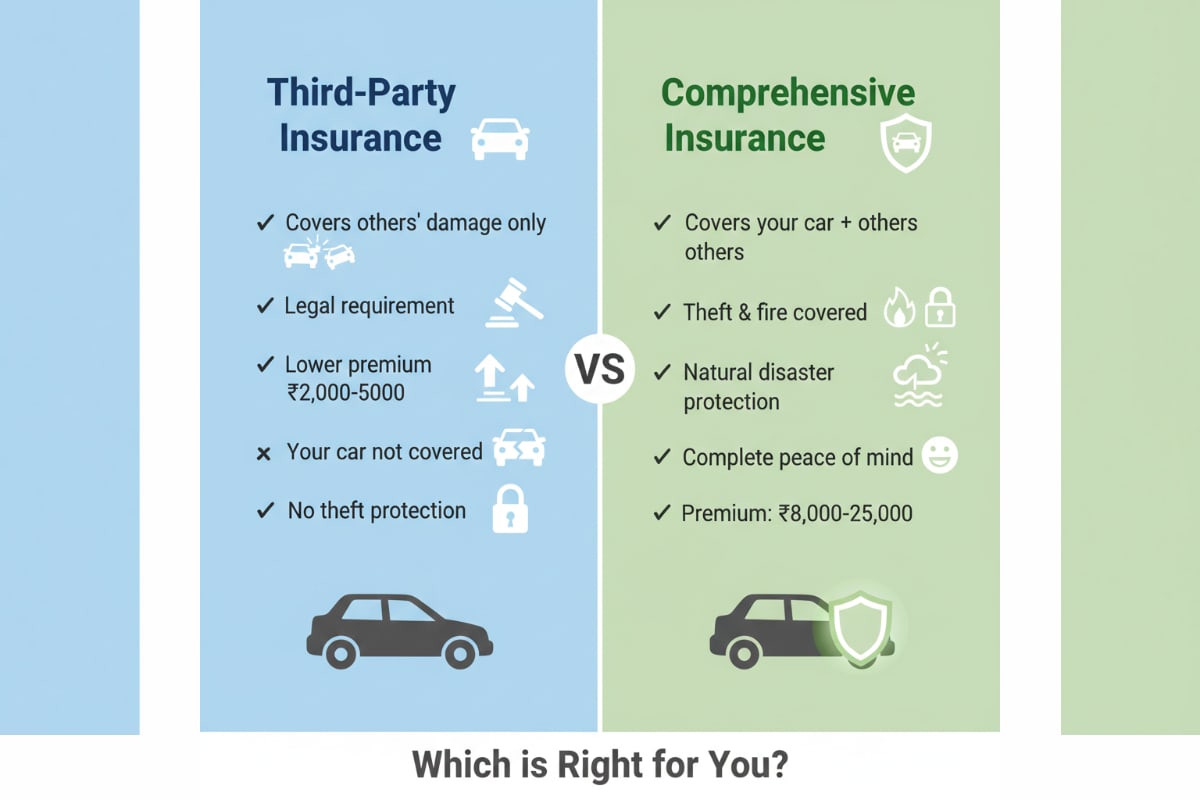
The main difference between these two types of motor insurance is what they protect. Third-party liability insurance is the bare minimum required by law and only covers damage you cause to others. Comprehensive insurance covers everything third-party insurance does, plus it also protects your own vehicle from damage, theft, and various other risks.
| Feature | Third-Party Liability | Comprehensive |
|---|---|---|
| Covers others' damage | ✓ Yes | ✓ Yes |
| Covers your vehicle | ✗ No | ✓ Yes |
| Theft coverage | ✗ No | ✓ Yes |
| Legal requirement | ✓ Mandatory | Optional (but recommended) |
| Premium cost | Lower | Higher |
Choosing between these options depends on your vehicle's value and your budget. If you own an expensive or new car, comprehensive insurance makes more sense because the cost of repairs or replacement would be very high. But if your car is old and has low market value, you might decide that paying only for third-party coverage is more economical since repair costs might not justify comprehensive insurance premiums.
What is Standalone Own Damage Insurance
Standalone own damage insurance is a unique type of policy that only covers damage to your own vehicle, without including third-party liability coverage. This option exists because the law allows you to buy third-party insurance and own-damage insurance separately from different companies. Many people don't know about this option and end up paying more than necessary.
This type of insurance makes sense in specific situations. For example, if you already have third-party insurance from one company but want better own-damage coverage, you can buy a standalone own-damage policy from another insurer. This flexibility lets you mix and match policies to get the best coverage at the best price. However, remember that you cannot drive legally without third-party insurance, so standalone own-damage insurance must always be combined with valid third-party coverage from somewhere.
Additional Benefits and Add-Ons in Motor Insurance
Basic comprehensive motor insurance is good, but you can make it even better by adding optional features called add-ons or riders. These extra coverages help protect you in specific situations that standard policies might not cover fully. While add-ons increase your premium slightly, they can save you significant money when you need them most.
Think of add-ons as customization options for your insurance. Just like you can add features to your car to make it suit your needs better, you can add features to your insurance policy. The key is choosing add-ons that match your actual risks and usage patterns. For example, if you drive frequently through flooded areas during monsoons, engine protection cover would be valuable for you.
Zero Depreciation Cover
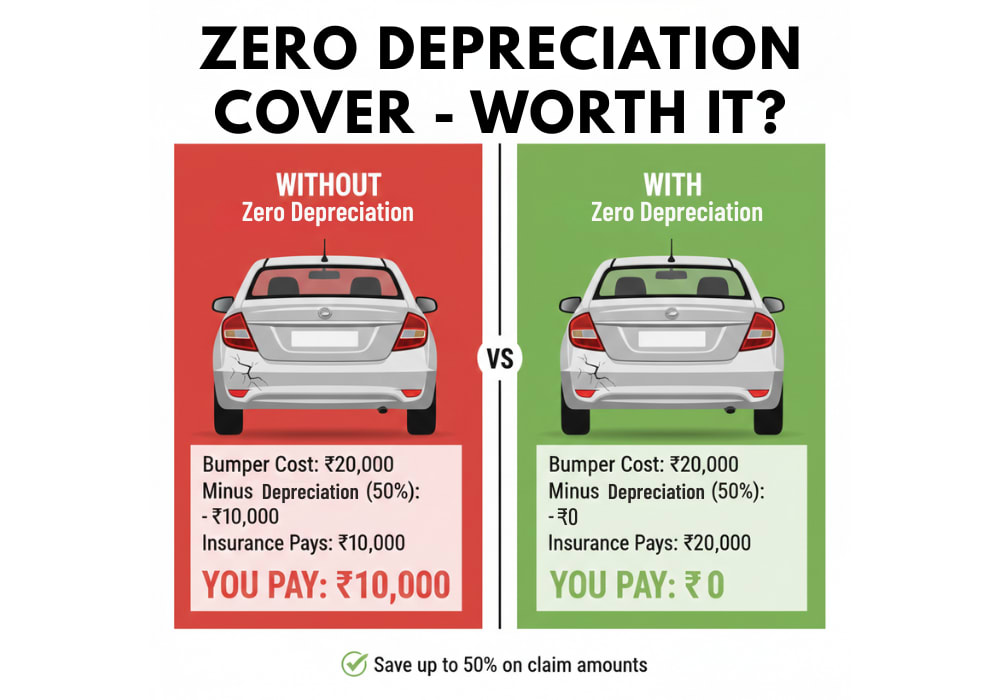
Zero depreciation (also called bumper-to-bumper) cover is one of the most popular add-ons in motor insurance. Normally, when your car gets damaged and you claim insurance, the company reduces the claim amount based on depreciation of your car's parts. With zero depreciation cover, you get the full cost of replacement parts without any depreciation deduction, which can significantly increase your claim amount.
This add-on is especially valuable for new cars where parts are expensive. For example, if your car's bumper needs replacement, a standard policy might pay only 50% of the cost after depreciation, but with zero depreciation cover, you get 100% coverage. This add-on typically increases your premium by about 15-20%, but it's worth it if you want maximum protection for your vehicle. However, most insurers only offer this for cars less than 5 years old.
Return to Invoice (RTI) Cover
Return to Invoice cover protects you from the biggest financial loss you can face with a vehicle - total loss or theft. In case your car is stolen or damaged beyond repair (total loss), a standard policy only pays the current market value of your vehicle, which is much less than what you originally paid. RTI cover ensures you get the full invoice value you paid when you bought the car.
This add-on is particularly important for new car owners. Imagine buying a car for ₹10 lakhs, and it gets stolen after one year. Without RTI, you might only receive ₹7-8 lakhs as the depreciated value. With RTI cover, you get the full ₹10 lakhs, allowing you to buy a similar new car without additional financial burden. This peace of mind is especially valuable in cities with high vehicle theft rates.
Roadside Assistance (RSA)
Roadside assistance is a convenient add-on that provides immediate help when your car breaks down or you face problems while driving. Services typically include emergency fuel delivery, flat tire changing, battery jumpstart, towing to the nearest garage, and even arranging alternate transport if your car needs major repairs. Some policies also offer locksmith services if you lock your keys inside the car.
RSA is incredibly useful in India where breaking down on highways or in unfamiliar areas can be stressful and potentially unsafe. Instead of waiting hours for help or paying expensive local mechanics, you just make one phone call to your insurance company and they arrange everything. Many insurers now include basic RSA free with comprehensive policies, but you can opt for premium RSA packages that offer more services and wider geographical coverage.
Engine Protection Cover
Engine protection cover is a critical add-on that protects your car's engine from water damage during floods and monsoons. In India, waterlogging is common during heavy rains, especially in cities like Mumbai, Kolkata, Chennai, and Bangalore. If you drive through flooded streets and water enters your engine, the repair or replacement cost can be ₹50,000 to ₹3,00,000 depending on your car model. Standard comprehensive insurance excludes engine damage from water ingress because it's considered preventable. With engine protection cover, you get full coverage for such damages without any deduction. This add-on costs only ₹500 to ₹2,000 yearly depending on your vehicle's cubic capacity and insurance provider. It's highly recommended if you live in flood-prone areas or frequently drive during monsoon season. However, the cover only works if you don't attempt to restart the engine after water enters—doing so voids the claim. Call for towing immediately if your car stalls in water.
Consumables Cover
Consumables cover is an add-on that includes items like engine oil, oil filters, nuts, bolts, washers, grease, AC gas, brake oil, coolant, and other small parts in your claim settlement. Normally, when you file an insurance claim for accident repairs, the insurer only pays for major parts like bumper, headlights, doors, or panels—they exclude consumables saying these are maintenance items. This means even if your claim is ₹50,000, you might have to pay ₹3,000 to ₹8,000 extra from your pocket just for consumables used during repairs. With consumables cover, all these small items are included in the claim amount, giving you a true cashless experience. The add-on premium is very affordable—typically ₹500 to ₹1,500 per year depending on your car's value and the insurance company. It's especially useful if you own a premium car where even small parts cost significantly more. Many people don't know about this add-on and end up paying thousands unnecessarily during claim settlement. When combined with zero depreciation cover, consumables cover ensures you pay almost nothing out of pocket for accident repairs.
How to Calculate Motor Insurance Premium
Premium depends on: vehicle age, model, city (metro vs non-metro), cubic capacity, previous claims, and chosen add-ons. Use online calculators on PolicyBazaar, Acko, or Digit for accurate quotes.
No-Claim Bonus (NCB) Explained
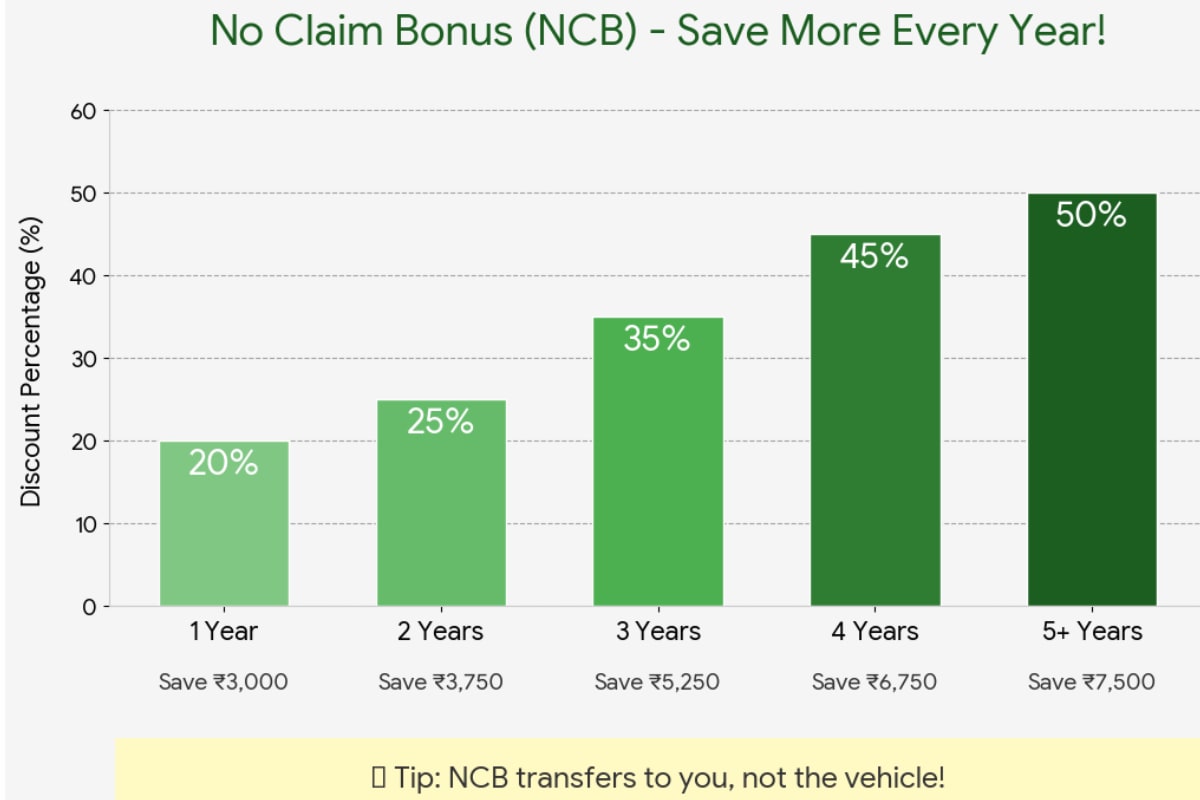
NCB rewards claim-free years with premium discounts: 20% after 1 year, 25% after 2 years, 35% after 3 years, 45% after 4 years, 50% after 5 years. NCB belongs to you, not the vehicle—transfer it when buying new cars.
Life Insurance Complete Guide
Life insurance is a contract between you and an insurance company where you pay regular premiums, and in return, the company promises to pay a sum of money to your chosen beneficiaries after your death. This financial protection ensures your family doesn't struggle financially if you're no longer around to support them. Life insurance is especially important if you're the main breadwinner in your family or have outstanding loans like a home loan.
There are many types of life insurance policies available in India, from simple term insurance that only pays after death to complex investment-linked plans that combine insurance with savings. The right choice depends on your age, income, family responsibilities, and financial goals. Many people make the mistake of either buying too little coverage or buying policies that don't match their actual needs. Understanding what life insurance truly offers helps you protect your loved ones properly.
Types of Life Insurance in India
Term Insurance (Best for Most People)
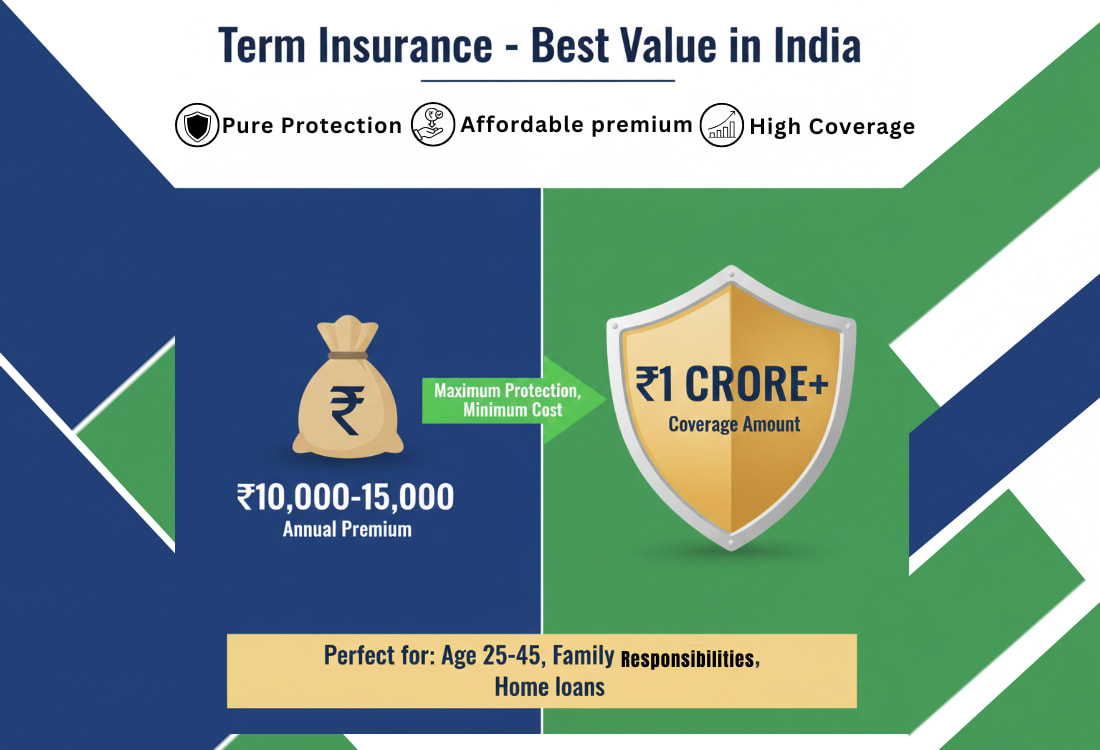
Term insurance is pure life protection without any investment or savings component. You pay a small premium yearly (₹10,000-15,000) and get very high coverage (₹1 crore or more). If you die during the policy term, your family receives the full sum assured amount tax-free. If you survive till the end of the policy term, you get nothing back—no maturity benefit or premium refund. This is perfect for young earners aged 25-45 who have family responsibilities like children's education, home loans, or dependent parents. Term insurance gives maximum financial security to your family at the lowest possible cost compared to any other life insurance type.
Endowment Plans
Endowment plans combine life insurance protection with forced savings in one policy. You pay high premiums (₹50,000 to ₹1,00,000 yearly) for 15-20 years and get both life cover plus a maturity amount when the policy ends. The life coverage is usually low (only ₹10-20 lakhs) compared to premiums paid, which is the biggest drawback. If you die during the policy term, your nominee gets the sum assured plus accumulated bonuses. If you survive, you receive the maturity amount which includes your premiums plus returns (usually 5-6% yearly). However, these returns are much lower than what you'd earn by investing the same money in mutual funds or even fixed deposits, making endowment plans a poor choice for wealth creation.
ULIP (Unit Linked Insurance Plans)
ULIPs combine life insurance with market-linked investments in equity and debt mutual funds. Part of your premium goes towards life cover, and the remaining amount is invested in funds you choose (aggressive, balanced, or conservative). The biggest problem with ULIPs is very high charges—premium allocation charges (up to 10% in first year), fund management charges (1-2% yearly), mortality charges, and policy administration charges eat into your returns significantly. After all these deductions, your actual investment amount becomes much smaller, reducing wealth creation potential. You're better off buying a separate cheap term insurance for protection and investing remaining money directly in mutual funds through SIPs, which gives better returns with lower costs and more flexibility.
Whole Life Insurance:
Whole life insurance provides life coverage until age 99 or 100, unlike term insurance which covers only till 60-70 years. You pay premiums for a limited period (10-30 years) but remain covered for your entire lifetime. The premiums are significantly higher than term insurance because the payout is guaranteed whenever you die—whether at 40, 60, or 90 years old. This type is useful for high-net-worth individuals doing estate planning, leaving inheritance for children, or covering funeral expenses without burdening the family. For regular middle-class families with limited budgets, whole life insurance is too expensive and unnecessary—term insurance covering your working years (till 60-65) is more practical and affordable.
How Much Life Insurance Do You Need?
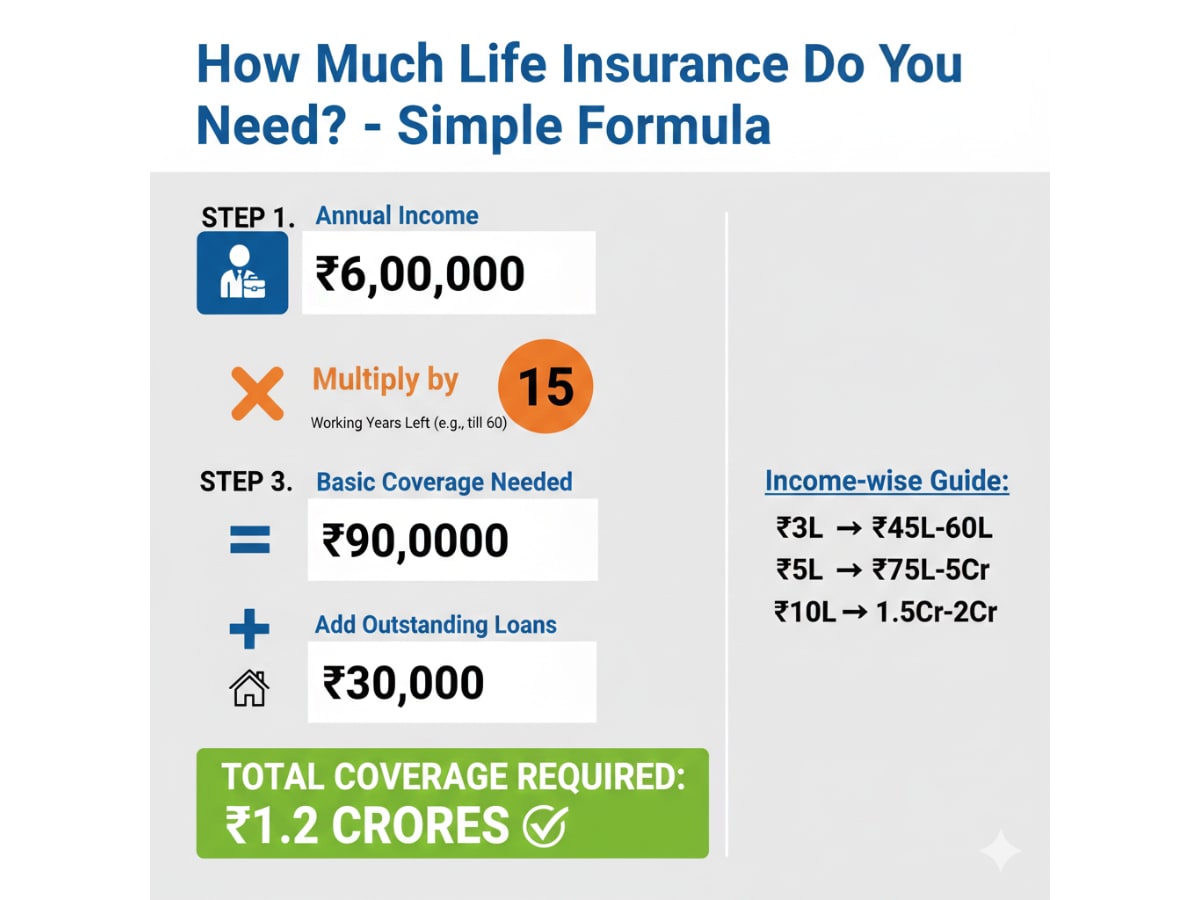
Calculate using Human Life Value (HLV) method: Annual income × Number of working years left. Or use simple formula: Annual income × 10-15 times. Minimum ₹50 lakhs for most middle-class families.
Life Insurance Tax Benefits
Premium paid qualifies for Section 80C deduction up to ₹1.5 lakhs yearly. Death benefit is tax-free under Section 10(10D) for nominees. Choose plans with premium less than 10% of sum assured to get full tax benefits.
Common Life Insurance Mistakes
Buying too little coverage: ₹10-20 lakhs won't support family for years. Choosing ULIPs/Endowment: Lower coverage, higher costs. Not disclosing health issues: Claims get rejected. Buying from LIC only: Private insurers offer better rates with similar reliability.
Best Life Insurance Providers 2026
Compare claim settlement ratios: HDFC Life (99.03%), Max Life (99.51%), ICICI Prudential (98.69%), SBI Life (98.47%), LIC (97.79%). Higher ratio means more claims paid without issues.
Health Insurance Complete Guide
Health insurance helps cover the cost of medical treatment, hospitalization, and sometimes even regular health checkups. With healthcare costs rising every year in India, a single hospitalization can wipe out your savings if you don't have proper health coverage. Health insurance protects you from this financial burden by paying for most of your medical expenses according to your policy terms.
Modern health insurance policies offer much more than just hospitalization coverage. They might include coverage for pre and post-hospitalization expenses, daycare procedures, ambulance charges, and even alternative treatments like Ayurveda or homeopathy. Some policies also offer cashless treatment at network hospitals, making the process hassle-free during emergencies. However, each policy has its own coverage limits, waiting periods, and exclusions that you need to understand before buying.
Individual vs Family Floater Plans
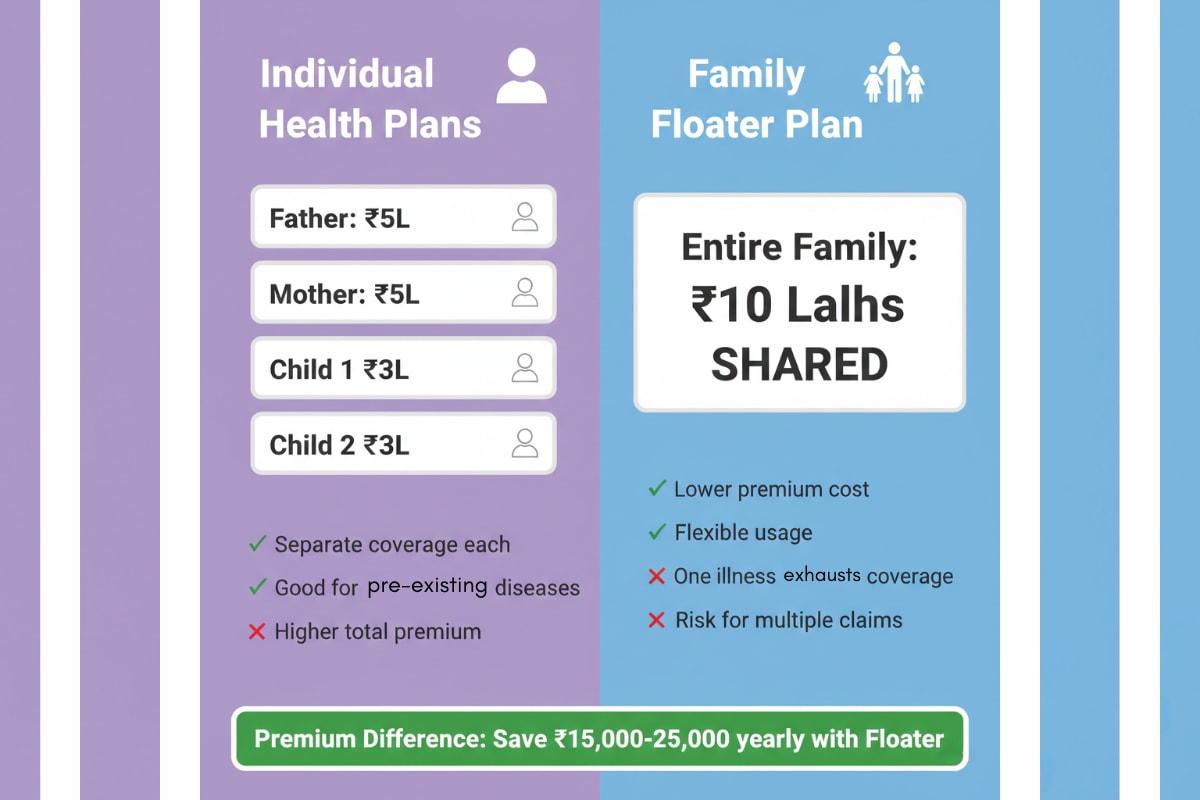
Individual Plans: Separate coverage for each person. Better if someone has pre-existing diseases. Premiums higher for multiple members.
Family Floater: One sum insured shared by all members. Cheaper premiums. Good for healthy families. Risk: One person's major illness exhausts coverage for others.
How Much Health Insurance Coverage Needed?
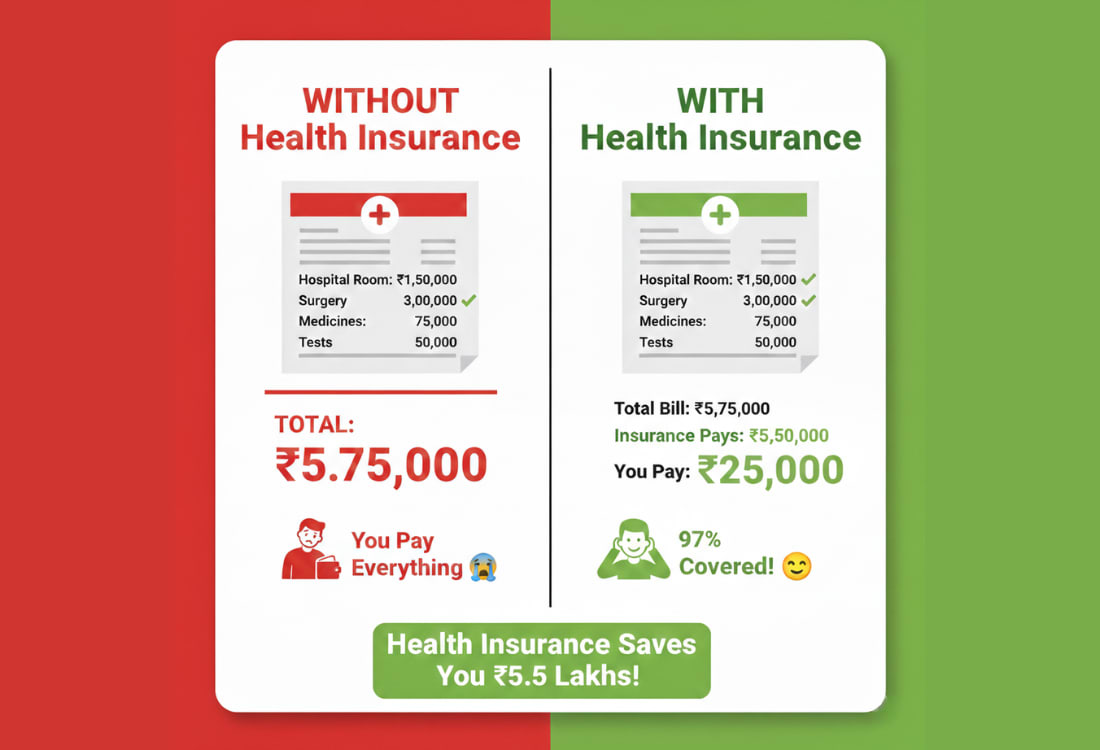
Minimum coverage: ₹5 lakhs for individuals, ₹10 lakhs for families. Metro city residents need ₹15-25 lakhs due to higher hospital costs. Add separate critical illness cover of ₹10-25 lakhs for serious diseases.
Understanding Key Health Insurance Terms
Waiting Period: Initial 30 days no claims allowed. Specific diseases have 2-4 year waiting. Pre-existing conditions covered after 2-4 years. Don't hide health issues—claims will be rejected.
Co-payment: You pay percentage of bill (10-20%), insurer pays rest. Reduces premium but increases out-of-pocket costs. Avoid if possible.
Room Rent Limit: Maximum daily room charges covered (₹3,000-5,000). Choose unlimited or high limits—ICU costs are very high.
Sub-limits: Restrictions on specific treatments like cataract surgery (₹40,000), knee replacement (₹1.5 lakhs). Choose plans with minimal sub-limits.
Cashless vs Reimbursement Claims
Cashless: Hospital directly settles bill with insurer. Works only at network hospitals. No cash needed upfront. Preferred during emergencies.
Reimbursement: You pay hospital, insurer repays later. Works at any hospital. Requires documents submission. Get money in 15-30 days.
Network Hospitals Importance
More network hospitals = easier cashless treatment. Check insurer has tie-ups with good hospitals near your home. Star Health (14,000+ hospitals), Care Health (19,000+), HDFC Ergo (13,000+).
Pre-Existing Disease Coverage
Declare all health conditions honestly: diabetes, blood pressure, thyroid, asthma, heart issues. Most insurers cover after 2-4 year waiting. Some plans like Star Health offer 1-year waiting. Never hide conditions—claims get rejected permanently.
Health Insurance Portability Rights
Switch insurers without losing benefits: no fresh waiting periods for completed years, accumulated bonus transferred, pre-existing waiting continues. Apply 45 days before renewal. Use portability to get better coverage or lower premiums.
Top Health Insurance Add-Ons
Best Health Insurance Companies 2026
Compare claim settlement: Star Health (90.89%), Care Health (94.00%), HDFC Ergo (94.14%), ICICI Lombard (89.52%), Niva Bupa (97.45%). Check customer reviews about claim experience, not just settlement ratios.
What is General Insurance
General insurance covers everything that life insurance doesn't. This includes insurance for your property, vehicle, health, travel, and business. Unlike life insurance which pays out after death or at policy maturity, general insurance protects you against specific risks and losses that can happen anytime. Each type of general insurance is designed to cover particular assets or situations.
In India, general insurance has become increasingly important as people own more assets that need protection. Your home, car, business equipment, jewelry, and even your overseas trips can all be insured under general insurance policies. These policies are usually valid for one year and need to be renewed regularly. The premium you pay depends on the value of what you're insuring and the level of risk involved.
Home Insurance (House & Contents)
Covers building structure and contents from fire, theft, floods, earthquakes, lightning, explosions. Coverage typically ₹10-50 lakhs. Premium: ₹3,000-10,000 yearly. Essential for homeowners but often ignored in India.
Travel Insurance (Domestic & International)
Covers trip cancellations, lost baggage, medical emergencies abroad, passport loss, flight delays. International travel medical costs are very high—₹50,000 hospital visit in USA costs ₹30-40 lakhs. Mandatory for Schengen visa. Premium: ₹500-3,000 per trip.
Fire Insurance for Business
Protects commercial property, stock, machinery from fire damage. Required by banks for business loans. Coverage based on asset value. Critical for shops, warehouses, factories.
Personal Accident Insurance
Covers death or disability from accidents. Pays lump sum to family. Very cheap—₹10-20 lakhs coverage for ₹500-1,000 yearly. Often bundled free with credit cards or accounts.
How to Avoid Insurance Agent Scams
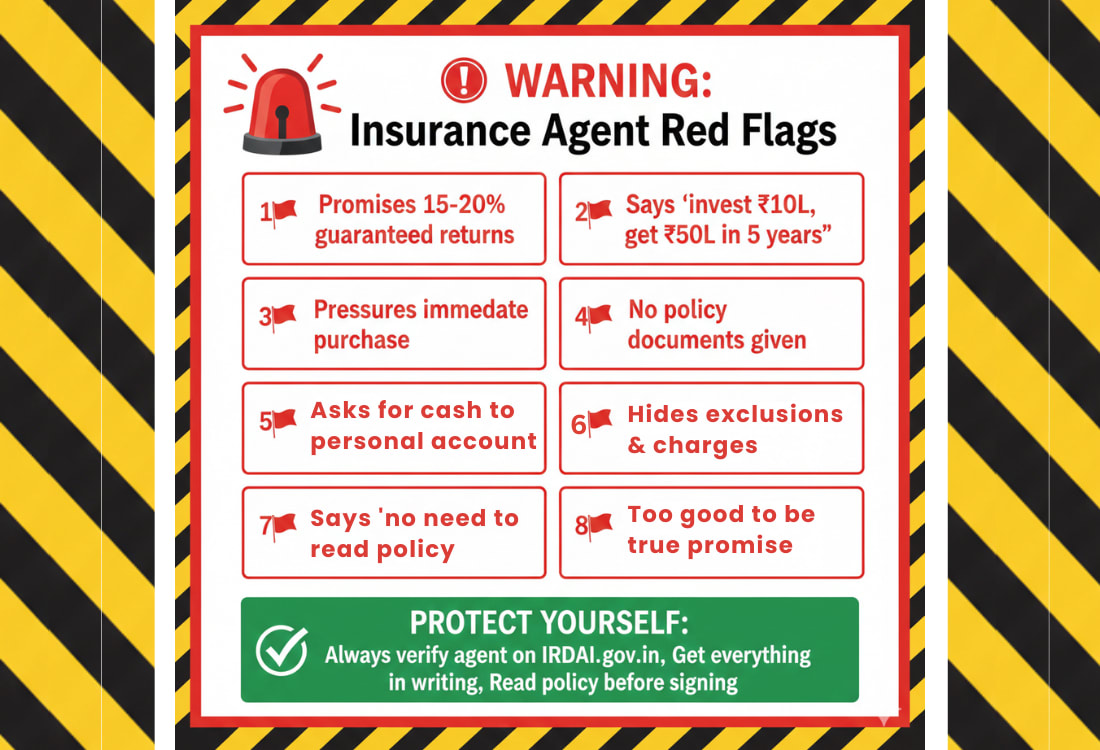
Many agents mis-sell policies for higher commissions. Learn to identify fake promises and protect yourself from fraud.
Common Agent Scams & Red Flags
How to Verify Agent Credentials
Check agent license on IRDAI website (www.irdai.gov.in). Verify agent code with insurance company directly. Get everything in writing—verbal promises mean nothing. Always pay premiums to company account, never agent's personal account.
What to Do If Scammed
File complaint with: 1) Insurance company grievance cell, 2) Insurance Ombudsman (free service), 3) IRDAI consumer affairs, 4) Police cybercrime cell. Keep all documents—policy papers, payment receipts, agent messages. Act within free-look period (15-30 days) to cancel mis-sold policy.
Mistake #1 - Choosing the Cheapest Policy Without Reading Terms
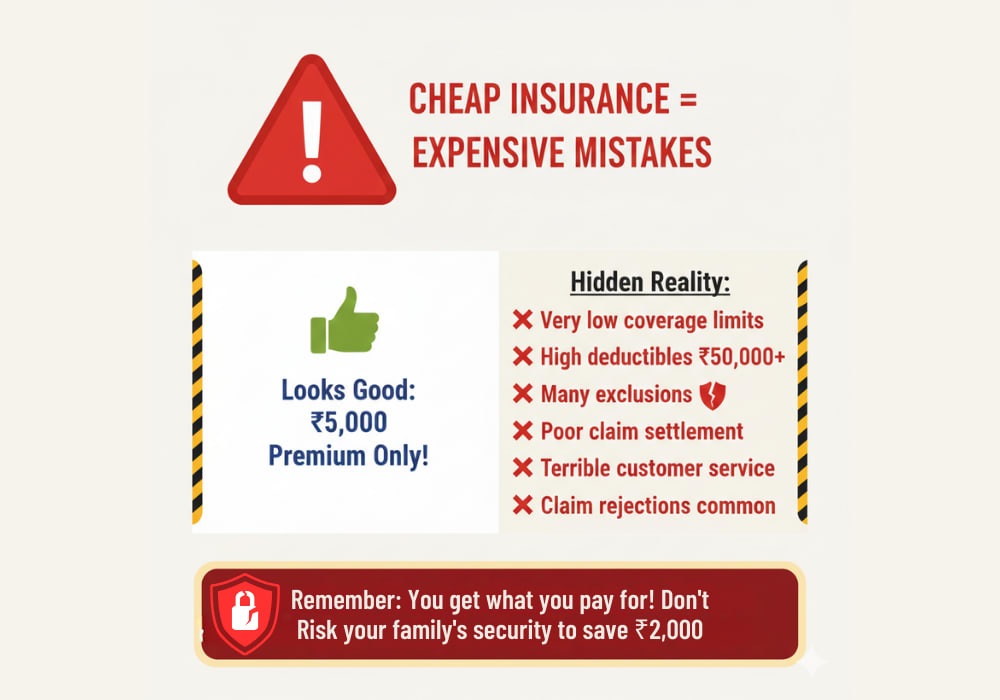
The biggest trap people fall into is hunting for the lowest premium without understanding what they're actually buying. Insurance isn't like buying groceries where cheaper always means better value. When it comes to insurance, the cheapest policy often provides the least coverage and has the most restrictions. You might save a few hundred rupees on premium, but end up paying thousands more when you actually need to use the insurance.
Price comparison is important, but it should never be the only factor in your decision. Two policies with similar premiums can have vastly different coverage levels, claim settlement ratios, and customer service quality. What matters is getting the right coverage for your needs at a fair price, not just the absolute lowest price. A slightly more expensive policy from a reliable insurer with better claim settlement might actually save you money in the long run.
What "Cheap Insurance" Actually Means
Cheap insurance policies are cheap for a reason. They typically have very low coverage limits, meaning they'll only pay up to a certain small amount for claims. They often come with high deductibles, so you have to pay more out of pocket before insurance kicks in. Many budget policies also have longer waiting periods for certain benefits and more exclusions that limit when they'll actually pay claims.
Some insurance companies offer cheap policies as loss leaders to attract customers, planning to deny claims through technicalities later. Others keep costs low by providing terrible customer service, making the claim process frustrating and difficult. You might spend months fighting with them just to get legitimate claims paid. Remember, insurance is a promise to help you in tough times. A cheap policy from an unreliable company is essentially a worthless promise.
Hidden Exclusions You Need to Know
Every insurance policy has exclusions - situations or conditions where they won't pay your claim. Cheap policies usually have many more exclusions buried in the fine print. For health insurance, they might exclude coverage for common conditions like knee replacement or cataract surgery. Motor insurance might exclude coverage if you were driving at night, or if the driver didn't have a valid license even if it was your friend borrowing your car.
Some exclusions are sneaky and unexpected. A travel insurance policy might not cover trip cancellations if you cancel for mental health reasons. Home insurance might exclude flood damage if you live in a "high-risk zone." Life insurance might not pay out if death occurs from certain pre-existing conditions you didn't know about. Always read the exclusions list carefully and ask questions about anything you don't understand before buying any policy.
How to Compare Policies Properly
Smart policy comparison involves looking at multiple factors, not just premium cost. Start by listing your actual needs - what risks do you face? What assets need protection? How much coverage do you need? Then compare policies based on coverage amount, claim settlement ratio (how many claims the company actually pays), network hospitals or garages, additional benefits included, and the insurer's reputation for customer service.
Use online comparison websites to see multiple policies side-by-side, but don't stop there. Read actual customer reviews about claim experience with each company. Check the Insurance Regulatory and Development Authority of India (IRDAI) website for official claim settlement statistics. Talk to people who have actually made claims with insurers you're considering. This thorough research takes time but can save you from regret later.
Mistake #2 - Not Understanding Your Coverage Limits
Coverage limits are the maximum amount your insurance company will pay for a claim. Many people confuse having insurance with having unlimited protection. They assume that because they have health insurance, all their medical bills will be covered, or because they have car insurance, any accident damage will be fully paid. This misunderstanding leads to nasty surprises when they discover their coverage has limits that leave them paying significant amounts themselves.
Every insurance policy clearly states its coverage limits in the policy document, but most people never read this carefully. Some policies have overall limits for the entire policy period, while others have per-claim limits or limits for specific types of expenses. Understanding these limits before you need to use your insurance is crucial for financial planning and avoiding disappointment during emergencies.
The Difference Between Coverage and Limits
Coverage refers to what situations or expenses your policy will pay for. Limits refer to how much they'll pay. For example, your health insurance might cover hospitalization (that's the coverage), but only up to ₹5 lakhs per year (that's the limit). Your motor insurance might cover accident damage (coverage) but only after you pay a ₹3,000 deductible (that's a limit on the coverage).
Some policies have sub-limits too, which are additional restrictions within the main coverage limit. For instance, your ₹5 lakh health insurance might have a sub-limit of ₹50,000 specifically for room rent per day. This means even though your total coverage is ₹5 lakhs, you can't use more than ₹50,000 of it on a hospital room per day. Understanding both the overall limits and these sub-limits is essential for realistic expectations about your insurance protection.
Common Scenarios Where Limits Fall Short

One of the most common problems happens with health insurance when someone needs expensive treatment like cancer therapy or organ transplant. Even a ₹10 lakh coverage might not be enough for advanced cancer treatment that could cost ₹15-20 lakhs. Similarly, in motor insurance, if you only have the minimum third-party coverage and you accidentally cause an accident that seriously injures someone, the medical and legal costs could far exceed your coverage limit.
Another frequent issue is with home insurance during natural disasters. Your policy might cover fire damage up to ₹20 lakhs, but if your home and belongings are worth ₹50 lakhs, you'd only get partial compensation. Travel insurance often has lower limits than people expect for medical emergencies abroad, where healthcare costs much more than in India. These situations where your coverage limit is too low can force you into debt despite having insurance.
How Much Coverage Do You Really Need?
Calculating the right coverage amount requires honest assessment of your risks and assets. For health insurance, consider your age, family medical history, and current healthcare costs in your city. A good rule is to have coverage of at least 10-15 times your annual income, with minimum coverage of ₹5 lakhs for individuals and ₹10 lakhs for families. For motor insurance, if your car is new or expensive, get coverage equal to or higher than the vehicle's market value.
Life insurance coverage should be at least 10-15 times your annual income to ensure your family can maintain their lifestyle if something happens to you. For home insurance, calculate the total cost to rebuild your home plus replace all contents - this is often much higher than people estimate. Remember, it's better to have slightly more coverage than you think you need rather than discovering you have too little when crisis strikes. Review and increase your coverage limits as your income, assets, and family responsibilities grow.
Mistake #3 - Ignoring Deductible Amounts
A deductible is the amount you must pay out of your own pocket before insurance coverage kicks in. For example, if your health insurance has a ₹10,000 deductible and your hospital bill is ₹60,000, you pay the first ₹10,000 and insurance covers the remaining ₹50,000. Many people ignore deductibles when choosing insurance because they're focused on premium costs and coverage amounts. However, deductibles have a major impact on how much you actually pay when you need to use your insurance.
Policies with higher deductibles usually have lower premiums because you're taking on more of the risk yourself. Conversely, lower deductibles mean higher premiums because the insurance company starts paying sooner. There's no universally right answer about what deductible to choose - it depends on your financial situation and how much risk you're comfortable with. Understanding deductibles helps you make an informed choice that balances premium affordability with claim-time costs.
How Deductibles Affect Your Out-of-Pocket Costs
Higher deductibles can save you money on premiums, but they mean you pay more each time you make a claim. If you have a ₹25,000 deductible on your motor insurance and you need minor repairs costing ₹15,000, you won't even claim insurance because it's less than your deductible - you'll pay the entire amount yourself. This means you're essentially self-insuring for smaller damages while only getting insurance help for major incidents.
Let's look at a practical example. A health insurance policy with zero deductible might cost ₹20,000 per year, while the same coverage with a ₹50,000 deductible might cost only ₹12,000. You save ₹8,000 annually on premiums with the deductible option. But if you get hospitalized and your bill is ₹1,50,000, you'll pay ₹50,000 out of pocket with the deductible policy versus ₹0 with the zero deductible policy. Whether this trade-off makes sense depends on your health, savings, and likelihood of needing care.
Choosing the Right Deductible for Your Budget
The right deductible balances what you can afford to pay upfront versus what you can afford in monthly premiums. If you have good savings and rarely make claims, a higher deductible with lower premiums might work well. You save money every year on premiums and can handle occasional higher out-of-pocket costs when needed. This strategy makes sense for young, healthy people buying health insurance or careful drivers buying motor insurance.
However, if you have limited savings or know you'll need frequent care or claims, a lower deductible with higher premiums is wiser. Yes, you pay more each month, but you won't be hit with large bills you can't afford when problems arise. For families with children or people with ongoing health conditions, low or zero deductible policies often work better despite higher premiums. Calculate your expected usage and emergency fund size to determine what deductible level fits your financial situation.
When High Deductibles Backfire
High deductibles become problematic when you face multiple claims in a short period or when your financial situation changes unexpectedly. Imagine choosing a ₹1,00,000 deductible health insurance to save on premiums. Then you suffer an injury requiring two surgeries within a year. You'd need to pay ₹1,00,000 out of pocket for each surgery before insurance helps - that's ₹2,00,000 you might not have, even though you thought you were "insured."
High deductibles also discourage people from seeking necessary care or repairs. Someone with high motor insurance deductible might delay fixing minor damage, which then worsens into major damage. A person with high health insurance deductible might avoid going to the doctor for worrying symptoms because they don't want to pay the deductible, only to end up with a more serious condition later. Insurance should encourage proper care and prompt repairs, not create barriers to them. If you find yourself avoiding using your insurance because of the deductible, it's too high for your situation.
Mistake #4 - Failing to Update Your Policy Regularly
Life doesn't stay the same, and neither should your insurance. One of the biggest mistakes people make is buying insurance once and then forgetting about it for years. They never update their coverage even though their life circumstances, income, family size, and assets have changed significantly. What was adequate protection five years ago might leave you severely underinsured today. Regular policy reviews and updates are essential to ensure your insurance continues to meet your actual needs.
Many people only think about their insurance when it's renewal time, and even then they just pay the premium without reviewing the coverage. They don't realize that major life events like marriage, having children, buying a house, or getting a promotion should trigger insurance updates. Insurance companies won't automatically increase your coverage to match your changing needs - you have to actively request changes and pay adjusted premiums. Neglecting these updates can leave dangerous gaps in your protection.
Life Changes That Require Policy Updates
Getting married is a major trigger for insurance updates. You'll likely want to add your spouse as a nominee on your life insurance and include them in your health insurance coverage. If your spouse works and contributes to household income, you both might need separate life insurance policies. Having a baby requires immediately adding them to your health insurance and significantly increasing your life insurance coverage since you now have dependents who rely entirely on you financially.
Other important life changes include: buying a home (needs home insurance or increased coverage), buying a new car (needs updated motor insurance), starting a business (may need business insurance), getting a significant raise (should increase life insurance proportionally), developing health conditions (might need specialized health riders), or sending kids to college (might need education insurance). Even moving to a different city can affect your insurance needs and rates. Review your policies after any major life event to ensure continued adequate protection.
The Risk of Being Underinsured
Being underinsured means having some insurance but not enough to actually protect you from financial disaster. It's often worse than having no insurance at all because it gives you false confidence. You think you're protected, so you don't save extra money for emergencies. Then when something major happens, you discover your coverage is inadequate and you don't have backup savings either. This double hit can be financially devastating.
A common example is someone who bought ₹10 lakh life insurance ten years ago when their salary was ₹4 lakhs annually. Now they earn ₹15 lakhs per year, have two children in school, and a home loan of ₹30 lakhs. That ₹10 lakh life insurance won't even pay off half their home loan, let alone provide for their family's living expenses and children's education. Similarly, someone who bought basic health insurance years ago might find it completely inadequate for today's inflated medical costs. Regular increases in coverage are necessary to keep pace with your growing financial responsibilities and rising costs.
Annual Review Checklist for Your Insurance
Set aside time each year, ideally around your birthday or financial year-end, to review all your insurance policies. Start by listing all current policies and their coverage amounts. Then assess your current situation: Has your income increased? Do you have new dependents? Have you acquired new assets? Are your current coverage amounts still sufficient given inflation and current costs? Have you developed new health conditions that need specific coverage? Has your family medical history revealed new risks?
Don't just review existing policies - also consider whether you need entirely new types of insurance. As your wealth grows, you might need coverage for assets you didn't have before, like jewelry insurance or liability insurance. If you've started traveling internationally, travel insurance becomes important. As you age, critical illness insurance might be worth adding. Your insurance portfolio should evolve throughout your life just like your investment portfolio does.
Mistake #5 - Not Bundling Policies for Discounts
Insurance bundling means buying multiple policies from the same insurance company. Most insurers offer discounts when you bundle policies because it costs them less to manage one customer with multiple policies than many customers with single policies. These discounts can range from 5% to 25% depending on the company and which policies you combine. Over time, bundling discounts can save you thousands of rupees while also simplifying your insurance management.
Many people don't even know bundling discounts exist because insurance companies don't always advertise them prominently. You often have to ask specifically about multi-policy discounts. Some people avoid bundling because they think they'll get better deals by shopping around for each type of insurance separately. While that can sometimes be true, you need to factor in the bundling discount and the convenience value when making comparisons. In many cases, bundling offers both savings and simplicity.
How Bundling Saves You Money
The most direct saving from bundling is the multi-policy discount on your premiums. For example, if you buy motor insurance and home insurance from the same company, you might get 10-15% off both policies. If your motor insurance costs ₹15,000 and home insurance costs ₹10,000, a 15% bundling discount saves you ₹3,750 annually - that's significant money over several years. The discount percentage usually increases as you add more policies, so someone with motor, health, and home insurance bundled might get 20-25% off.
Beyond direct premium discounts, bundling saves money in less obvious ways. You avoid multiple processing fees that each policy might charge separately. You might get better negotiating power with your insurer for claim settlements or coverage terms when you're a customer with multiple policies. Some insurers offer additional perks to bundled customers like faster claim processing, dedicated customer service numbers, or free annual policy reviews. All these benefits add up to meaningful savings and better service over time.
Which Policies Can Be Combined?
The most common bundling combination is motor and home insurance since the same general insurance companies offer both. You can usually bundle your car insurance, two-wheeler insurance, and home insurance together for good discounts. Some insurers also let you bundle personal accident insurance or travel insurance with your motor policy. Health insurance and life insurance can sometimes be bundled if the company offers both, though many specialize in only one type.
In India, most bundling opportunities are within general insurance (motor, home, travel) or within life and health insurance. You can't usually bundle general insurance with life insurance because they're often separate companies, even if they have similar names. However, some large financial groups have multiple insurance arms, letting you bundle across categories. When talking to an insurance agent or company, always ask: "What other policies do you offer, and will I get a discount if I combine them?" This simple question can uncover savings you didn't know existed.
When Bundling Doesn't Make Sense
Bundling isn't always the best choice. If one company offers excellent motor insurance but poor health insurance, bundling for the discount might mean accepting inferior coverage in one area. Always compare the bundled price with discounts against buying each policy separately from the best provider for that type. Sometimes the discount doesn't compensate for better coverage, lower claim rejection rates, or superior customer service you'd get from specialized insurers.
Bundling also becomes problematic if it locks you into one insurer when better options emerge. If you have four policies bundled and you're unhappy with the company's claim service, switching becomes complicated and expensive because you lose all bundling discounts. It's like putting all your eggs in one basket - convenient until that basket has problems. In such cases, bundling two or three policies for moderate discounts while keeping others separate might be a smarter strategy that balances savings with flexibility.
Mistake #6 - Overlooking Exclusions and Fine Print
Every insurance policy has pages of terms and conditions that most people never read carefully. These documents contain crucial information about exclusions - specific situations where your insurance won't pay claims. Ignoring this fine print is like signing a contract without reading it. You might think you're protected from certain risks, only to discover during a crisis that those exact situations are excluded from coverage. This shock and disappointment can be avoided by thoroughly reading your policy documents before buying.
Insurance companies are legally required to disclose all terms, conditions, and exclusions in your policy document. They don't hide this information - it's all there, usually in a section clearly labeled "Exclusions" or "What is Not Covered." The problem is that this section is often written in legal or technical language that's hard for regular people to understand. Don't let complicated wording stop you from reading it. If you don't understand something, ask your agent or the company to explain it in simple terms before you buy the policy.
Most Commonly Missed Exclusions
In health insurance, some of the most overlooked exclusions include waiting periods for specific diseases (usually 2-4 years for things like hernias or cataracts), exclusions for pre-existing conditions for the first few years, and exclusions for certain types of treatments like cosmetic surgery, dental work, or fertility treatments. Many policies also don't cover mental health treatment or alternative medicine unless you specifically buy those riders.
Motor insurance commonly excludes coverage if the driver doesn't have a valid license, if the vehicle was being used for commercial purposes when it's registered as personal, or if the vehicle was being driven under influence of alcohol. Damage from normal wear and tear, mechanical breakdown, or driving in restricted areas might also be excluded. Home insurance often excludes flood damage, earthquake damage, or damage from lack of maintenance. These are not minor exclusions - they cover many common situations where people expect their insurance to help.
What Insurance Companies Don't Cover
Beyond specific exclusions, there are general categories of situations that almost no insurance covers. Most policies exclude coverage for intentional damage or illegal activities. If you deliberately damage your own car, no insurance will pay for it. If you injure someone while committing a crime, liability insurance won't protect you. Insurance also doesn't cover losses from war, nuclear disasters, or acts of terrorism unless you buy special coverage for those risks.
Insurance companies also won't cover claims where you didn't follow policy requirements. For example, most health insurance requires you to notify them within 24 hours of hospitalization. If you forget to inform them and try to claim after being discharged, they might reject the claim. Motor insurance won't pay if you didn't renew before it expired and had an accident during the gap. These procedural exclusions are often overlooked but can completely invalidate your coverage if you don't follow them carefully.
Questions to Ask Before Signing
Before buying any insurance policy, prepare a list of specific questions about exclusions and limitations. Ask: "What are the top three reasons claims get denied under this policy?" Ask about waiting periods: "When does coverage actually start for different types of situations?" Ask about limits: "Are there any sub-limits I should know about?" Ask about requirements: "What do I need to do to ensure my claim won't be rejected?" These direct questions force the agent or company to give you clear answers.
Don't be satisfied with vague or technical answers. If something isn't clear, keep asking until you understand it fully. Ask for examples: "If I have a two-wheeler accident while my friend with a valid license was driving my bike, will it be covered?" Specific scenario questions reveal how exclusions work in practice. Also ask: "Can you show me the exact section in the policy document where this is mentioned?" This ensures you can verify the information later and refer back to it if needed. Remember, asking questions before buying is much easier than fighting claim denials after an incident.
Mistake #7 - Letting Your Policy Lapse
A policy lapse happens when you miss paying your premium and your coverage expires. This is one of the most financially damaging mistakes because it leaves you completely unprotected at a time when you might need insurance most. Life doesn't pause when your insurance lapses - accidents, illnesses, and disasters can happen during that uninsured gap, leaving you to pay all costs from your pocket. Even worse, letting your policy lapse can have long-term negative consequences that affect you even after you reinstate coverage.
People usually don't let policies lapse intentionally. It happens due to forgetfulness, cash flow problems, or thinking "I'll renew it next month." But insurance companies have strict deadlines. Most offer a grace period of 15-30 days after the due date, but after that, your policy is considered lapsed. During the grace period and after lapse, you have zero coverage. Any claim filed during this time will be rejected outright, regardless of the circumstances. This makes policy lapses extremely risky, especially for essential coverage like motor insurance where driving without valid insurance is also illegal.
Consequences of Coverage Gaps
The immediate consequence of a lapsed policy is loss of coverage, but the problems extend far beyond that. If you try to renew a lapsed health insurance policy, you'll likely have to serve waiting periods again for certain conditions and pre-existing diseases. Any health issues that developed during the lapse period might be considered pre-existing conditions and excluded from your new policy. You essentially lose all the benefits you had built up, like no-claim bonuses or accumulated coverage enhancements.
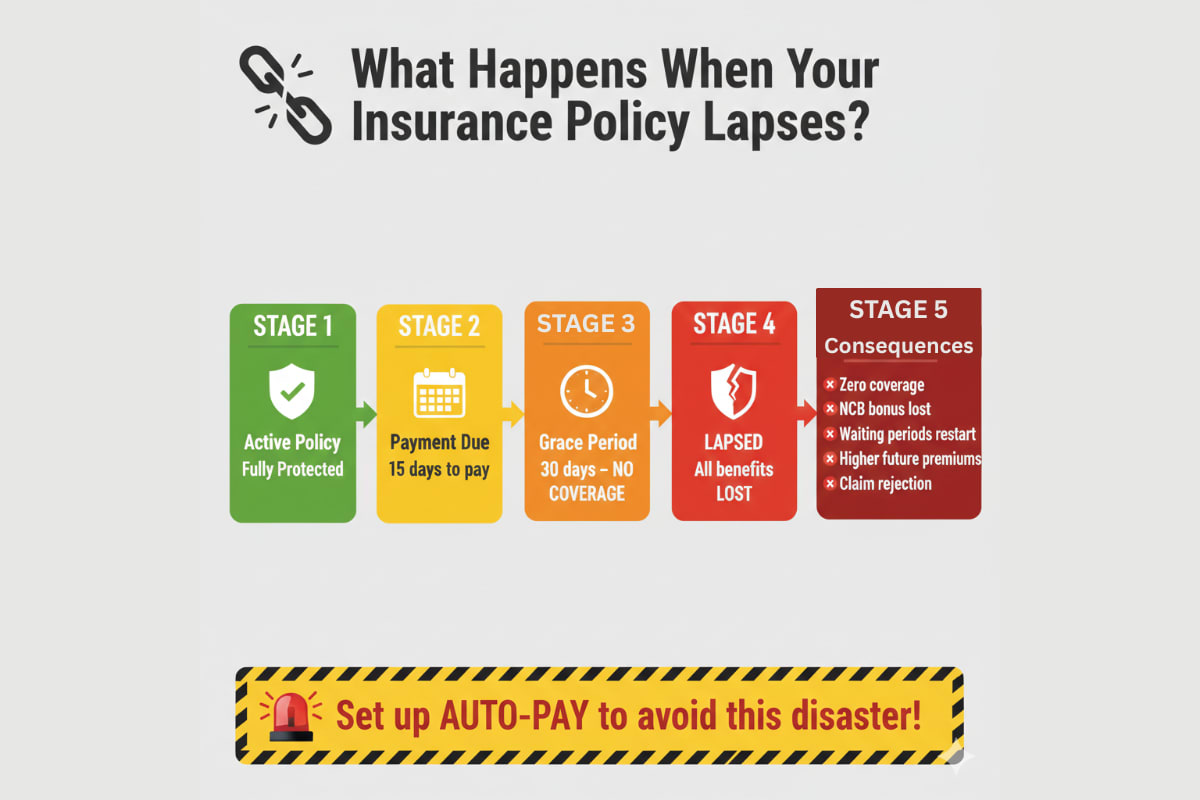
For motor insurance, letting your policy lapse means losing your no-claim bonus (NCB), which could have given you discounts up to 50% on your premium. When you renew after a lapse, you start from zero NCB again, making your insurance more expensive. If you had an accident during the lapse period, even if you didn't make a claim because you had no coverage, you might be required to disclose it when buying new insurance, which could increase your premiums or lead to rejection. Some insurers also charge higher premiums or refuse coverage to people with a history of lapses, seeing them as higher-risk customers.
How Lapses Affect Future Premiums
Insurance companies view policy lapses negatively because they suggest financial instability or lack of commitment to staying insured. When you apply for new insurance or try to reinstate lapsed coverage, the insurer will ask about your previous insurance history. A history of lapses can result in higher premiums because you're seen as a higher risk. Some insurers might even reject your application entirely, especially for health insurance if you've developed health conditions during the uninsured period.
The impact is particularly harsh with health insurance. If your health insurance lapsed and you developed a medical condition during the gap, that condition will be treated as pre-existing when you buy new insurance. You'll face waiting periods (often 2-4 years) before you can claim for that condition, even though you're paying premiums all that time. This effectively means you've lost years of coverage continuity that you had built up before the lapse. In some cases, insurers might permanently exclude certain conditions that developed during your uninsured period.
Setting Up Auto-Pay to Avoid Lapses
The easiest way to prevent policy lapses is setting up automatic premium payment through your bank. Most insurance companies offer auto-debit facilities where they automatically deduct your premium from your bank account or credit card on the due date. This eliminates the risk of forgetting to pay manually. Just ensure you always have sufficient balance in the linked account around your premium due dates. Set up calendar reminders a few days before the auto-payment date to verify funds are available.
If you're uncomfortable with auto-debit, set multiple reminders on your phone, calendar, and email for renewal dates. Some insurance companies and policy management apps send renewal reminders via SMS, email, and app notifications. Enable all these reminder options so you have multiple warnings before your policy expires. Many people set a reminder not just for the due date but also two weeks and one month before, giving them plenty of time to arrange payment even if they're traveling or facing temporary cash flow issues.
Additional Critical Insurance Mistakes
Beyond the major mistakes already covered, there are several other common errors that can cost you money or leave you poorly protected. These additional mistakes might seem less obvious, but they're equally important to avoid. Many of these relate to how you interact with insurance companies, how you manage your policies over time, and how you make decisions about insurance purchases. Being aware of these pitfalls helps you navigate the insurance world more effectively and get the maximum value from your coverage.
Mistake #8 - Not Shopping Around Annually
Many people buy insurance and then automatically renew with the same company year after year without checking if better options exist. This loyalty might seem convenient, but it often costs you money. Insurance rates change constantly based on competition, new products, and company strategies. A company that offered the best rate when you first bought might not be competitive anymore. Meanwhile, other insurers might have launched better products or reduced their premiums to attract customers like you.
Shopping around at renewal time doesn't mean you must change companies every year. It means doing a quick market comparison to ensure you're still getting good value. Check 3-4 competing insurers offering similar coverage and compare premiums, benefits, and reviews. If you find a significantly better deal, you can either switch (if your current insurer has no outstanding claims or special built-up benefits) or use the competing quotes to negotiate better terms with your current insurer. Many companies offer retention discounts to customers who are considering switching.
Even if you don't find cheaper options, shopping around helps you stay informed about new features, add-ons, or coverage types that might benefit you. You might discover that your current policy is missing important coverage that competitors include as standard. Or you might learn about new insurance products that fit your evolving needs better than your existing policies. This annual exercise of comparison shopping keeps you educated about insurance and ensures you're making informed decisions rather than just following the path of least resistance.
Mistake #9 - Providing Inaccurate Information
When filling out insurance applications, some people intentionally or accidentally provide incorrect information. This is extremely dangerous because it gives insurance companies grounds to deny claims later. Common inaccuracies include hiding pre-existing health conditions, understating your annual mileage for motor insurance, misrepresenting the value of assets being insured, or lying about smoking habits for life insurance. These might seem like small lies to get lower premiums, but they can completely invalidate your entire policy.
Insurance companies investigate claims thoroughly, especially large ones. They cross-check your application information with medical records, vehicle service records, and other documents. If they find you provided false information during application, they can legally deny your claim and cancel your policy, even if the false information wasn't directly related to the claim. For example, if you lied about smoking when buying life insurance, the company might deny a claim related to a car accident death, even though smoking didn't cause the accident. The lie itself is the issue.
Always provide complete, accurate, and honest information on insurance applications, even if it means paying higher premiums. If you're unsure about something, ask for clarification rather than guessing. If you made an honest mistake on your application, contact the insurer immediately to correct it - most companies allow corrections within a certain timeframe. Remember, insurance is a legal contract based on utmost good faith. Violating that principle by providing false information can result in losing all the money you paid in premiums with nothing in return when you actually need help.
Mistake #10 - Skipping Professional Advice When Needed
Insurance can be complex, especially when dealing with large coverage amounts or specialized needs. While it's good to educate yourself about insurance basics, some situations warrant consulting professional insurance advisors or financial planners. Many people skip professional advice either to save the consultation fee or because they're overconfident about their own understanding. This can lead to choosing wrong policies, getting inadequate coverage, or missing important coverage aspects that an expert would have caught.
Professional advisors are particularly valuable when you're buying insurance for the first time, when your financial situation is complex (owning businesses, multiple properties, or having substantial assets), or when making major life decisions like retirement planning that involve insurance. A good advisor considers your entire financial picture - income, expenses, assets, liabilities, family situation, and future goals - to recommend appropriate insurance coverage. They can spot gaps in your coverage that you might miss and suggest combinations of policies that work well together.
When seeking professional advice, look for certified financial planners or insurance advisors who work on a fee basis rather than commission-only agents. Commission-based agents might push policies that give them higher payouts rather than what's best for you. Fee-based advisors earn their money from your consultation payment, so they have less conflict of interest. You can also consult multiple advisors and compare their recommendations. While professional advice costs money upfront, it often saves you much more in the long run through better policy selection and avoiding costly mistakes.
Useful Insurance Tools & Calculators
Use these free online tools to calculate exact coverage needed and compare policies easily.
Life Insurance Calculators
Health Insurance Comparison Tools
PolicyBazaar: Compare 20+ insurers, filter by budget/features. Coverfox: Side-by-side plan comparison with network hospitals. InsuranceDekho: Check claim settlement ratios and customer reviews.
Motor Insurance Premium Calculators
Acko: Instant quotes with breakdown of charges. Digit: Shows impact of add-ons on premium. HDFC Ergo: NCB calculator shows discount savings. Policybazaar: Compares 15+ insurers with one form.
How to Use Calculators Effectively
Enter accurate information—wrong inputs give wrong results. Try multiple calculators to cross-verify. Don't just pick cheapest—check what coverage you actually get. Use calculators as starting point, read policy documents before buying.
Where to Buy Insurance Online
Direct from Insurers: HDFC Life, Digit, Acko websites—sometimes cheapest. Aggregators: PolicyBazaar, Coverfox—compare multiple at once. Banks: HDFC, ICICI, SBI—convenience but limited options. Always verify IRDAI license before buying.
Take Control of Your Insurance Today
Avoiding these 10 insurance mistakes in 2026 can save you thousands of rupees and prevent stressful claim denials when you need coverage most. Remember, insurance isn't just about buying the cheapest policy and forgetting about it. It's about choosing the right coverage for your specific needs, reviewing it regularly as your life changes, understanding what you're actually buying, and maintaining continuous coverage without lapses.
Don't wait for an emergency to discover gaps in your protection. Take an hour today to review your current policies, check for exclusions you might have missed, verify your coverage amounts are adequate, and ensure your premiums are set to auto-pay. If you don't have insurance yet, use this guide to make informed choices that protect your financial future without unnecessary overspending.
Insurance is one of the most important financial tools you have to protect yourself and your family. By avoiding these common mistakes, you transform insurance from a confusing burden into a reliable shield that gives you peace of mind and financial security. Your future self will thank you for taking insurance seriously today.
Need help?
📞 Contact Us: Choose The Best Policies
If you want to get an Insurance, please contact us; we provide the insurance service at an affordable price.
I am a Policybazaar agent, and I can guide you correctly and help you get the right insurance, giving you complete peace of mind. We will be with you from start to finish – that's what we do as agents. We provide Motor, Life, and Health insurance, and you can get the right information and insurance by contacting us with our expert and experienced team. Contact us without hesitation in India.
Frequently Asked Questions
How often should I review my insurance policies?
You should review your insurance policies at least once a year, ideally before renewal dates. Additionally, review your policies whenever you experience major life changes such as marriage, having children, buying a home, getting a significant raise, or experiencing health changes.
What happens if I miss my insurance premium payment?
Most insurance companies provide a grace period of 15-30 days after the due date during which you can still pay your premium without penalty. If you don't pay within the grace period, your policy will lapse completely.
Is the cheapest insurance policy always a bad choice?
Not necessarily. A cheap policy from a reputable insurer that meets your needs can be a smart choice. Always compare value, coverage, and exclusions rather than focusing only on price.
How do I know if I have enough insurance coverage?
For life insurance, coverage should typically be 10-15 times your annual income. For health insurance, a minimum of ₹5–10 lakhs is recommended depending on family size and city.
What is the difference between comprehensive and third-party car insurance?
Third-party insurance covers damage caused to others, while comprehensive insurance also protects your own vehicle from accidents, theft, fire, and natural disasters.
Can I have insurance from multiple companies?
Yes. Many people choose different insurers for motor, health, and life insurance to get the best benefits for each type.
What should I do if my insurance claim is rejected?
Request a written explanation, review your policy, and file a complaint with the insurer if needed. You can escalate the issue to the Insurance Ombudsman.
Are add-ons in motor insurance worth buying?
Add-ons like zero depreciation, roadside assistance, and engine protection can provide significant financial protection depending on your usage.
How does no-claim bonus work in motor insurance?
No-claim bonus is a premium discount you earn for claim-free years, starting around 20% and going up to 50%.
Should I buy insurance online or through an agent?
Online policies are cheaper and faster, while agents provide personalized guidance. Choose based on your comfort and insurance knowledge.





Please do not enter any spam links in the comment box.